 by Admin
 When an FDI enterprise decides to invest in a new manufacturing facility in Vietnam, it is not truly investing in concrete, steel structures, or MEP systems. It is investing in production capacity for the next 20 to 30 years.
That investment only begins to generate value when the production line operates reliably, the first products roll off the line, and revenue starts to be recognized.
From a financial perspective, therefore, construction cost is only one part of the investment equation.
What ultimately determines the effectiveness of a project is the period between the investment decision and the moment the factory begins generating revenue.
Cost of delay: the largest cost that often goes unseen
For many years, investors typically focused on a familiar question: “How much will construction cost?”
Today, especially in large-scale industrial projects, that question is increasingly being replaced by another: “How much will the business lose if the project is delayed?”
This is what is known as the Cost of Delay: the economic impact resulting from bringing a project into operation later than planned.
Unlike construction costs, the Cost of Delay does not appear in budgets or construction contracts. Yet it can have a direct and significant impact on the overall return on investment.
According to Siemens' study The True Cost of Downtime, Fortune Global 500 manufacturers lose approximately USD 1.4 trillion annually due to unplanned production downtime, equivalent to roughly 11% of their annual revenue.
Another study by McKinsey on gigafactory projects estimated that delaying the commissioning of a 40 GWh battery plant by six months could place approximately USD 250 million in business value at risk. This illustrates that, for large-scale industrial projects, every day of delay not only increases construction-related costs but also postpones the point at which the business can begin generating revenue.
.webp)
Cost of Delay often starts with small decisions
What makes the Cost of Delay particularly challenging is that it rarely originates from a single major failure.
More often, it begins with seemingly minor decisions: a design modification, coordination conflicts between disciplines, rework in the field, delayed drawing approvals, or information that was not properly communicated among stakeholders.
Any individual issue may delay the project by only a few days.
However, when multiple issues accumulate over time, they trigger a chain reaction that disrupts construction schedules, affects equipment installation, postpones commissioning activities, and ultimately delays the factory’s official start of production.
This is why DINCO no longer views schedule management merely as a responsibility. We see project schedules as the outcome of the quality of decisions made throughout the entire project lifecycle.
.webp)
Reducing Cost of Delay by reducing poor decisions
Once the Cost of Delay is recognized as a risk management issue, investors naturally adopt a different approach.
Instead of waiting for problems to emerge on-site and then reacting, they focus on identifying and eliminating risks during the design and planning phases. This is where BIM takes on a fundamentally different role.
For many years, BIM was primarily viewed as a tool for creating sophisticated 3D models.
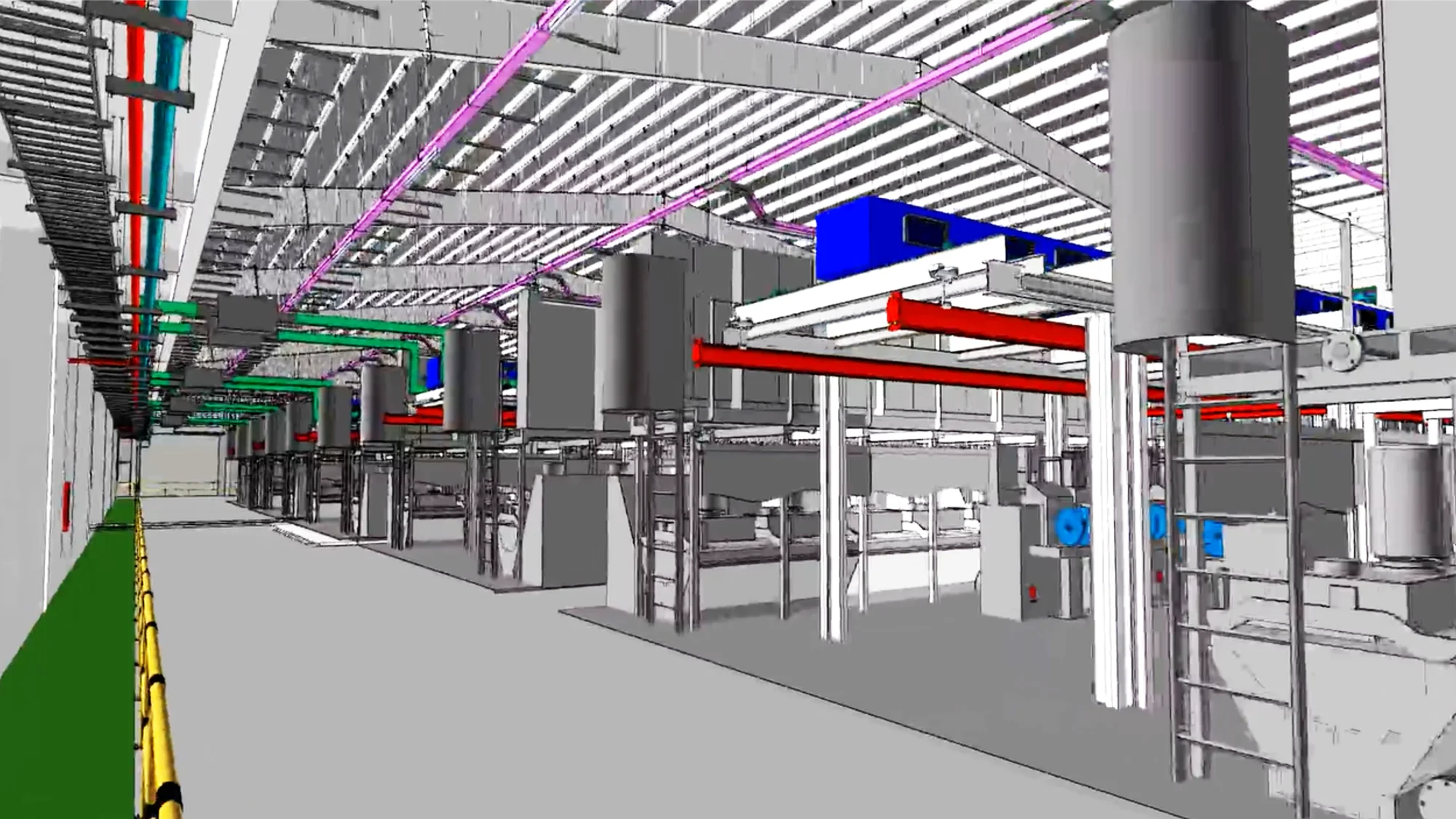
Today, its greater value lies in helping project stakeholders understand the consequences of decisions early, when the cost of change is still relatively low. By integrating architectural, structural, and MEP disciplines within a shared data environment, clashes and conflicts can be identified long before construction begins rather than during execution.
This means fewer instances of rework, fewer field changes, reduced schedule disruptions, and, most importantly, a lower risk of incurring Cost of Delay. International studies have also demonstrated that BIM's value extends well beyond 3D visualization. Research published in Scientific Reports in 2026 reported reductions in rework-related wasted time of up to 70-85%, while other studies have shown that BIM significantly improves cost and schedule control through early clash detection and more effective multidisciplinary coordination.
In other words, BIM cannot eliminate every project risk. However, it can significantly reduce the likelihood of errors that may ultimately result in Cost of Delay.
From schedule management to protecting investment performance
A project completed on schedule is not necessarily a successful project.
If production equipment cannot yet be installed, commissioning activities are delayed, or the factory is not ready for operations, the investment has not yet begun generating value. This is why an increasing number of FDI investors no longer measure project success by the construction completion date. Instead, they measure success by the date on which the factory begins generating revenue.
Ultimately, what businesses seek to shorten is not merely the construction period.
What they truly want to reduce is the time between the investment decision and the first revenue generated.
That is also why BIM is increasingly viewed as a project management and investment optimization tool rather than simply a design technology.
When contractor selection is no longer based solely on price
For many years, companies selected contractors based on three familiar criteria: price, schedule, and construction capability. These factors remain critically important.
However, for high-tech industrial projects, a new question is becoming increasingly important: Which contractor is best equipped to help us reduce the Cost of Delay?
This is no longer a conversation about software or technology alone. It is about a contractor’s ability to help investors make better decisions, make them earlier, and make them with greater certainty.
Ultimately, a contractor’s value will no longer be measured solely by the number of projects completed, but by its ability to help clients protect the performance of their overall investment.
This is also how DINCO views BIM: not merely as a design tool, but as a methodology that helps reduce the Cost of Delay, accelerate factory start-up, and protect investment value from the very first decisions made throughout the project lifecycle.
Leave a comment